 LicenseManager

For a decade, selling a Mac app outside the Mac App Store had a default answer: Paddle. It took the payment, handled VAT and sales tax as a merchant of record, and its Mac SDK showed an activation dialog and checked license keys. Many indie Mac apps still run on it.
Paddle’s current platform, Paddle Billing, is built for SaaS subscriptions, and has no license keys of its own: the licensing of the Mac SDK belongs to Paddle Classic. A new Mac app on Paddle today needs a separate licensing service anyway, and that’s when developers look at the Paddle alternatives: other merchants of record like FastSpring, Lemon Squeezy and Polar, simpler stores like Gumroad, marketplaces like Setapp and the Mac App Store, and Stripe paired with a licensing service. Or they keep Paddle for payments, and add licensing next to it. This guide compares them on fees, taxes and licensing, for a Mac app.
What Paddle does for a Mac app
To compare fairly, list what you’d replace:
- Checkout: a payment page, with cards, Apple Pay and PayPal.
- Merchant of record: Paddle is the seller for tax authorities, so it collects and pays VAT, GST and sales tax worldwide, and sends invoices.
- Fees: 5% + $0.50 per transaction, with payment processing included.
- Licensing (Classic): license keys, an activation dialog, and activation limits through the Mac SDK.
- Payouts in your currency, and chargeback handling.
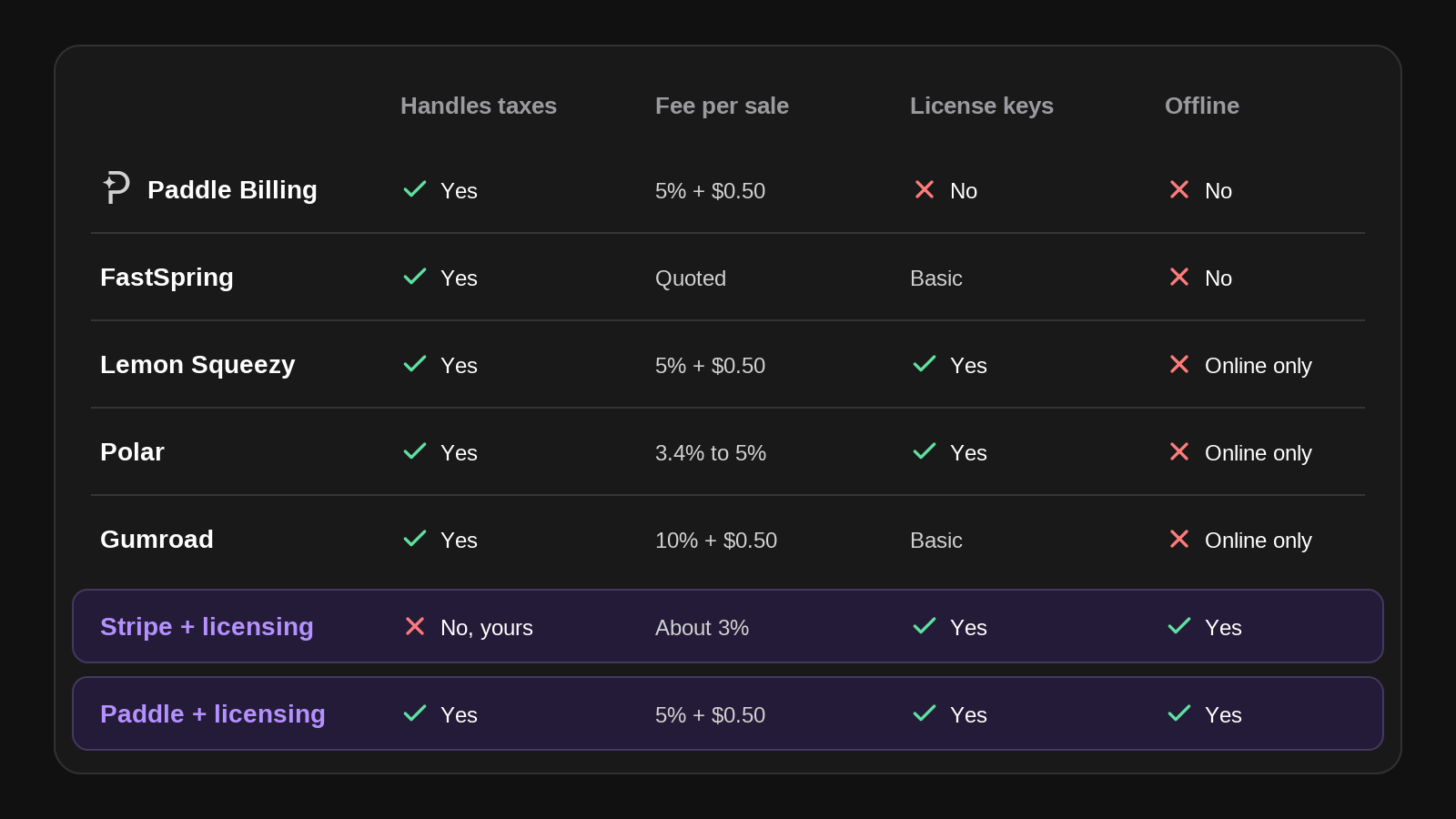
The alternatives cover different subsets. The biggest split is between services that are a merchant of record (they handle taxes) and those that aren’t (you do, with tools like Stripe Tax).
Merchants of record
They replace Paddle most directly: you never register for VAT, and you get one payout.
FastSpring
The other long-time choice of Mac developers, used by indie apps for years. A merchant of record with a mature checkout, subscriptions, coupons, upgrade pricing and invoices for business customers. Pricing is quoted rather than listed, and depends on your volume. License keys exist as a fulfillment option (a list of keys, or a generator you host), but activation limits and offline checks are yours to build or buy.
Best for: established apps with volume, B2B customers who need invoices, and upgrade pricing between major versions.
Lemon Squeezy
Shutting down: Lemon Squeezy closed sign-ups on November 16, 2026, and stops processing payments on March 31, 2027. Its replacement, Stripe Managed Payments, is a merchant of record without license keys: pair it with a licensing service. Already on Lemon Squeezy? See Lemon Squeezy alternatives and how to migrate its license keys.
A merchant of record for digital products, now owned by Stripe. 5% + $0.50 per sale, plus 1.5% for payments from outside the US and 0.5% on subscriptions. License keys are built in, with activation limits per product variant and an API to activate, validate and deactivate them. Validation is online only, so a Mac app needs its own caching to work offline.
Best for: solo developers who want taxes handled and simple keys, at the same price as Paddle.
Polar
An open source merchant of record aimed at developers. 5% + $0.50 per sale on the free plan, down to 3.4% + $0.30 on paid plans. License keys are a “benefit” attached to a product, with optional activation limits, and customers rotate keys and free devices in its portal. Validation is an API call, online only.
Best for: developers who like open source tooling and sell subscriptions alongside one-time purchases.
Gumroad
The simplest setup: a product page, a download and optional license keys. 10% + $0.50 per direct sale, plus card processing. Its verify API returns how many times a key was used, but enforcing a limit is up to your app.
Best for: a first paid app, a small utility, or testing demand before investing in a setup.
Marketplaces
Setapp
A subscription marketplace for Mac apps: customers pay one monthly fee for a catalog, and developers receive a share based on how much their app is used. No checkout, no keys, no taxes to handle, and access to Setapp’s subscribers. Apps are reviewed for inclusion, and the revenue depends on usage, not on a price you set.
Best for: an extra channel, alongside your own sales, for apps people open often.
The Mac App Store
Apple sells the app: 15% commission under the Small Business Program (under $1 million a year), 30% above, taxes handled, customers’ trust and search included. In exchange, the sandbox, review on every update, no real trials, and no customer emails. Many apps sell on the store and directly at once. See Mac App Store vs selling direct.
Stripe with a licensing service
The other path splits Paddle’s role in two: Stripe takes the payment, and a licensing service handles keys and activations.
- Fees: Stripe’s card fees, about 3% in most countries, plus Stripe Tax if you use it.
- Taxes: yours. Stripe Tax calculates and collects VAT and sales tax, and tells you where you pass a registration threshold, but registering and filing are on you. In the EU, the OSS scheme lets you file VAT for every member country in one return.
- Licensing: as complete as the service you pick: activation limits per Mac, signed tokens for offline use, trials, version locks, a customer portal.
- Customers and data: in your own Stripe account. Moving to another licensing service later doesn’t move your payments.
It costs less per sale than a merchant of record, and more of your time on taxes. For an app that sells mostly in a few countries, or a company that already files VAT, it’s usually the cheaper option. For a solo developer selling everywhere, a merchant of record’s extra 2% buys real peace of mind. Paddle vs Stripe goes through that choice in detail.
Keep Paddle, add a licensing service
The alternative to Paddle may not be another payment provider. What Paddle Billing lacks is licensing, not checkout or tax handling: keep Paddle as your merchant of record, and let a licensing service create the keys from Paddle’s events.
- Fees: Paddle’s 5% + $0.50, plus the licensing service, usually a flat monthly price.
- Taxes: still Paddle’s.
- Licensing: as complete as with Stripe: activations per Mac, offline tokens, trials, version locks, a portal for lost keys.
- Migration: if you’re on Paddle Classic, you move to Billing and import your existing keys, so customers keep theirs.
Check that the service supports Paddle Billing, not only Classic’s old webhooks, and both one-time and subscription prices. Paddle license keys explains how keys are delivered from Paddle payments, with or without a service.
Fees on a $49 Mac app
For 100 sales a month at $49, $4,900 in revenue, before taxes:
| Option | Fees per month | Taxes | Licensing |
|---|---|---|---|
| Paddle | About $295 (5% + $0.50) | Handled | Separate service needed on Paddle Billing |
| Lemon Squeezy (closing March 2027) | About $295, more for non-US cards | Handled | Built in, online only |
| Polar | $295 on the free plan, less on paid plans | Handled | Built in, online only |
| Gumroad | About $540 (10% + $0.50), plus card processing | Handled | Basic |
| Mac App Store | About $735 (15%) | Handled | Apple’s |
| Stripe and a licensing service | About $150 in card fees, plus the licensing plan | Yours | Full |
| Paddle and a licensing service | About $295, plus the licensing plan | Handled | Full |
The gap grows with your price and volume: at 1,000 sales a month, the difference between 3% and 5% + $0.50 is over $1,400 a month.
How to choose
- You want taxes handled and need basic keys: Polar, with your own offline caching in the app.
- You sell to businesses, with invoices and upgrade pricing: FastSpring, or Stripe with Stripe Invoicing.
- You want the lowest fees and full licensing, and can handle tax filing: Stripe with a licensing service.
- You want taxes handled and full licensing: Paddle or Stripe Managed Payments, with a licensing service fed by its webhooks.
- You want more channels: add Setapp or the Mac App Store next to your direct sales, not instead of them.
Migrating from Paddle Classic? Export your customers and their license keys first. A licensing service that can import existing keys lets customers keep the key they have: see migrating to LicenseManager.
Where LicenseManager fits
LicenseManager is the licensing half of the Stripe path, and of the Paddle one. Connect your Stripe account or your Paddle Billing account, and each payment creates a license key and emails it, with no backend. The macOS SDK is a Swift package that validates keys, limits activations per Mac, stores everything in the Keychain, works offline with signed tokens, and runs sandboxed and notarized. Customers find lost keys and free old Macs in the customer portal, and Stripe or Paddle subscriptions renew and expire licenses on their own. It isn’t a merchant of record itself: with Paddle, taxes are Paddle’s; with Stripe, they stay yours. See selling with Paddle.
Wrapping up
Paddle alternatives for a Mac app fall in three groups: merchants of record that also replace Paddle’s tax handling (FastSpring, Stripe Managed Payments, Polar, Gumroad), marketplaces that sell for you (Setapp, the Mac App Store), and a licensing service paired with Stripe, cheaper per sale with taxes on your side, or with Paddle, which keeps taxes off your plate.
Choose on the two questions that matter most: who files your taxes, and how much licensing your app needs offline. Then set up the rest with how to sell a Mac app outside the Mac App Store and how to add license keys to a Mac app.