 LicenseManager

Lemon Squeezy’s migration tooling only goes one way: to Stripe Managed Payments, and only if your business is in one of the 37 locations it supports. If you’re based in India, Brazil, Turkey, Indonesia or any other country outside that list, Lemon Squeezy’s email told you to find “another provider” before March 31, 2027. Some sellers in supported countries want to leave anyway, for PayPal, or to keep a merchant of record that isn’t Stripe.
Migrating from Lemon Squeezy to Paddle means rebuilding your products in Paddle, moving your card subscriptions with Lemon Squeezy’s intake form, switching your checkout, and finding a new home for your license keys, which Paddle Billing doesn’t generate. There’s no one-click tool for it, but it’s a well-trodden path: Paddle is a merchant of record like Lemon Squeezy, with the same 5% + $0.50 base fee. This guide goes through it in order.
Why Paddle after Lemon Squeezy?
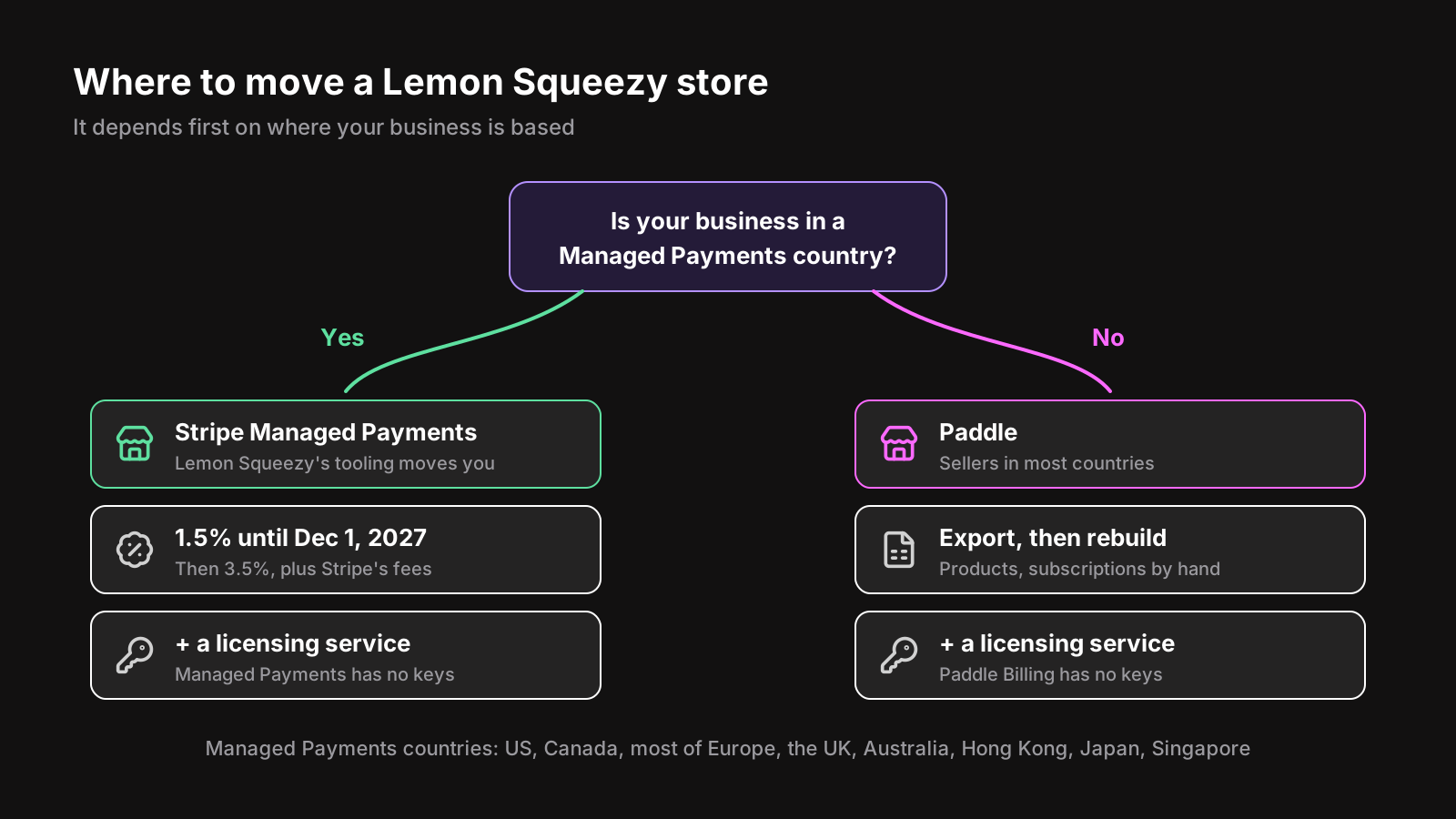
Paddle is the closest thing to Lemon Squeezy that isn’t Stripe:
- It’s a merchant of record. Paddle sells to your customers and handles sales tax and VAT worldwide, like Lemon Squeezy did. Your tax situation doesn’t change.
- It accepts sellers from most countries, including many Managed Payments doesn’t support.
- Same base price: 5% + $0.50 per transaction, without Lemon Squeezy’s surcharges for international cards and subscriptions.
- PayPal is supported at checkout, which Managed Payments doesn’t offer.
What it doesn’t have is license keys: Paddle Billing, the version every new account gets, dropped them. Paddle license keys tells that story. So the move has two halves: payments to Paddle, keys to a licensing service.
If your country is supported by Managed Payments, compare first: Lemon Squeezy’s migration rate makes Managed Payments cheaper until December 2027, and its tooling does more of the work. See Stripe Managed Payments vs Paddle.
Step 1: export everything from Lemon Squeezy
Before building anything in Paddle, take what you’ll need out of Lemon Squeezy:
- Orders: from the Orders page, Export. The CSV is emailed to you, with each order’s customer, product, variant, amounts and taxes.
- License keys: not in the orders export. Export them with the API, see step 5.
- Subscriptions: note each active subscription, its customer, variant, price and next renewal date.
- Tax documents and payout reports, which you’ll need for your accounts once the store closes.
Step 2: create your products and prices in Paddle
Sign up for Paddle, get your account approved, and recreate your catalog:
- One Paddle product per Lemon Squeezy product, with one price per variant: Personal $49, Team $149, Monthly $9.
- Set the tax category of each product, like standard digital goods or SaaS.
- Keep the same prices for existing customers. If you’re changing prices, do it later, not during the move.
- Recreate the discount codes you still use.
Work in Paddle’s sandbox first: it’s a separate account with test cards, where you can try the whole flow.
Step 3: move your subscriptions
This is the delicate part. You can’t move a subscription from one merchant of record to another without the customer’s card.
Card subscriptions: Lemon Squeezy offers a migration intake form, in Settings → Migration, to move card subscriptions to another provider. Fill it in early, with Paddle as the destination, and ask Paddle’s team how they import them: Paddle has a migration team for sellers bringing existing subscriptions.
PayPal and other subscriptions can’t be transferred. Their customers have to subscribe again:
- Email them with a Paddle checkout link for their plan, ideally with a discount covering what they’d lose.
- Let their Lemon Squeezy subscription run until the end of its period, then cancel it.
- Do it well before March 31: after that date, Lemon Squeezy stops renewing, and an unpaid customer is a lost one.
Step 4: switch your checkout
Lemon Squeezy’s checkout URLs and overlays don’t redirect anywhere after the shutdown. Replace each one:
- Buy buttons on your website: Paddle Checkout, as an overlay or inline, with Paddle.js and your price ids.
- Buy buttons in your app: open the checkout in the browser. Paddle Checkout in an Electron app and in a Tauri app show the whole flow, back to the app unlocked.
- Webhooks: anything listening to Lemon Squeezy’s webhooks, like a CRM or Slack notifications, now listens to Paddle’s.
From this day, new sales happen in Paddle. Keep the Lemon Squeezy store alive for existing subscriptions until they’ve moved.
Step 5: move your license keys
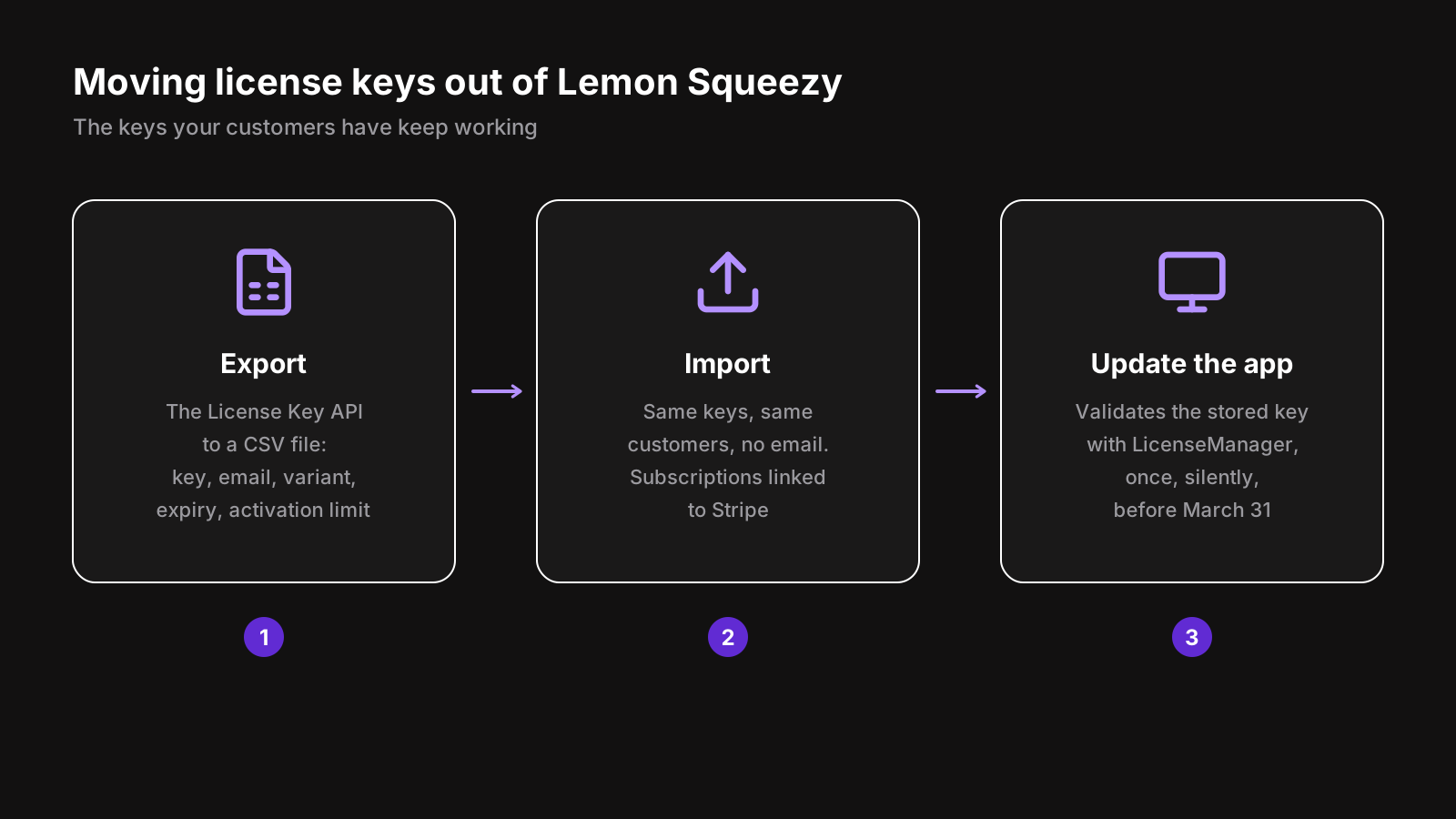
If you sell software with keys, this is the step that decides whether April 1 is quiet. Your customers have Lemon Squeezy keys, and your app checks them with Lemon Squeezy’s License API. Paddle won’t take over either.
- Export the keys with the Lemon Squeezy API: a short script writes them to a CSV file with each key’s customer, variant, expiration and activation limit. The script is in how to migrate Lemon Squeezy license keys.
- Import them into a licensing service, with the same keys, and without emailing anyone.
- Connect the licensing service to Paddle, so each new Paddle sale creates a key and emails it, like Lemon Squeezy did.
- Link the subscription keys to their new Paddle subscriptions, so renewals extend the imported keys instead of creating new ones.
- Ship an app update that validates keys with the licensing service, reusing the key the previous version stored, so nobody types it again.
LicenseManager does steps 2 to 4 from the dashboard: a CSV import that reads Lemon Squeezy’s columns, a Paddle integration that creates keys from Paddle transactions and subscriptions, and a paddle_subscription_id column to link the keys of moved subscriptions. The migration guide has the details.
Step 6: ship the app update before the deadline
Every version of your app that calls api.lemonsqueezy.com stops validating if Lemon Squeezy’s License API stops answering, and nothing says it won’t after March 31. Ship the new version in December or January, with auto-updates on (Electron, Tauri), and email the customers still on an old version in March.
Lemon Squeezy vs Paddle: what changes for you
| Lemon Squeezy | Paddle | |
|---|---|---|
| Fee | 5% + $0.50, plus 1.5% outside the US, 0.5% on subscriptions | 5% + $0.50 |
| Merchant of record | Yes | Yes |
| Seller countries | Most | Most |
| PayPal | Yes | Yes |
| Checkout | Hosted, overlay, storefront | Overlay or inline, hosted checkout |
| License keys | Built in | No, on Paddle Billing |
| File delivery | Built in | No |
| Migration tooling | Not to Paddle | Paddle’s migration team |
Edge cases
Refunds of Lemon Squeezy orders after the move: Lemon Squeezy handles them until it closes. After March 31, ask its support.
Customers who bought on both: the same email in Lemon Squeezy and Paddle makes one customer in LicenseManager, with both licenses.
Prices in other currencies: Paddle sets local prices per currency. Check that your converted prices match what your customers paid on Lemon Squeezy.
Your Paddle account isn’t approved yet: Paddle reviews new sellers, which can take days. Apply first, before anything else.
Where LicenseManager fits
LicenseManager is the licensing half of a Paddle store:
- Each Paddle transaction creates a license key for the prices you map, emailed to your customer, and each subscription keeps its license valid while it’s paid. See license keys for Paddle.
- Your Lemon Squeezy keys import as they are, from the CSV file, linked to their Paddle subscriptions.
- SDKs for Electron, Tauri and Swift validate keys, limit machines and work offline.
- A flat monthly price, free up to 100 active licenses, on top of Paddle’s fee: see pricing.
We’ll import your keys with you for free: see leaving Lemon Squeezy.
Wrapping up
Migrating from Lemon Squeezy to Paddle is the path for stores Managed Payments can’t take, and for sellers who want PayPal or another merchant of record than Stripe. Rebuild your catalog in Paddle, move card subscriptions with Lemon Squeezy’s intake form, switch your checkout, and move your license keys to a licensing service connected to Paddle, with the same keys.
Start with the Paddle account approval and the subscriptions, which take the longest. For the timeline, see Lemon Squeezy is shutting down, and for the other options, Lemon Squeezy alternatives.