 LicenseManager

On November 16, 2026, Lemon Squeezy announced it’s winding down. New sign-ups closed the same day, and the store you’ve been selling through will stop processing payments, renewals included, on March 31, 2027. If you sell software there, you have about four and a half months to move your checkout, your subscriptions, and the license keys your customers already have.
Lemon Squeezy is shutting down because Stripe, which bought it in 2024, wants one merchant of record product instead of two: Stripe Managed Payments, built by the Lemon Squeezy team. Lemon Squeezy’s tooling moves products, customers and card subscriptions to it, but not everything: license keys, file delivery and PayPal subscriptions are left to you. This article covers the dates, what moves and what doesn’t, and a checklist to get through it without losing a customer.
What is happening to Lemon Squeezy?
Lemon Squeezy is a merchant of record for digital products: it sells your software on your behalf, handles sales tax and VAT, and delivers files and license keys. In its goodbye post, the company explains that after joining Stripe, the team built Managed Payments, Stripe’s own merchant of record, and that running two platforms no longer makes sense.
The deadline is firm. The post says Lemon Squeezy “won’t be able to extend” it. Until March 31, 2027, your store keeps working as it does today: you can keep selling while you prepare.
The Lemon Squeezy shutdown timeline
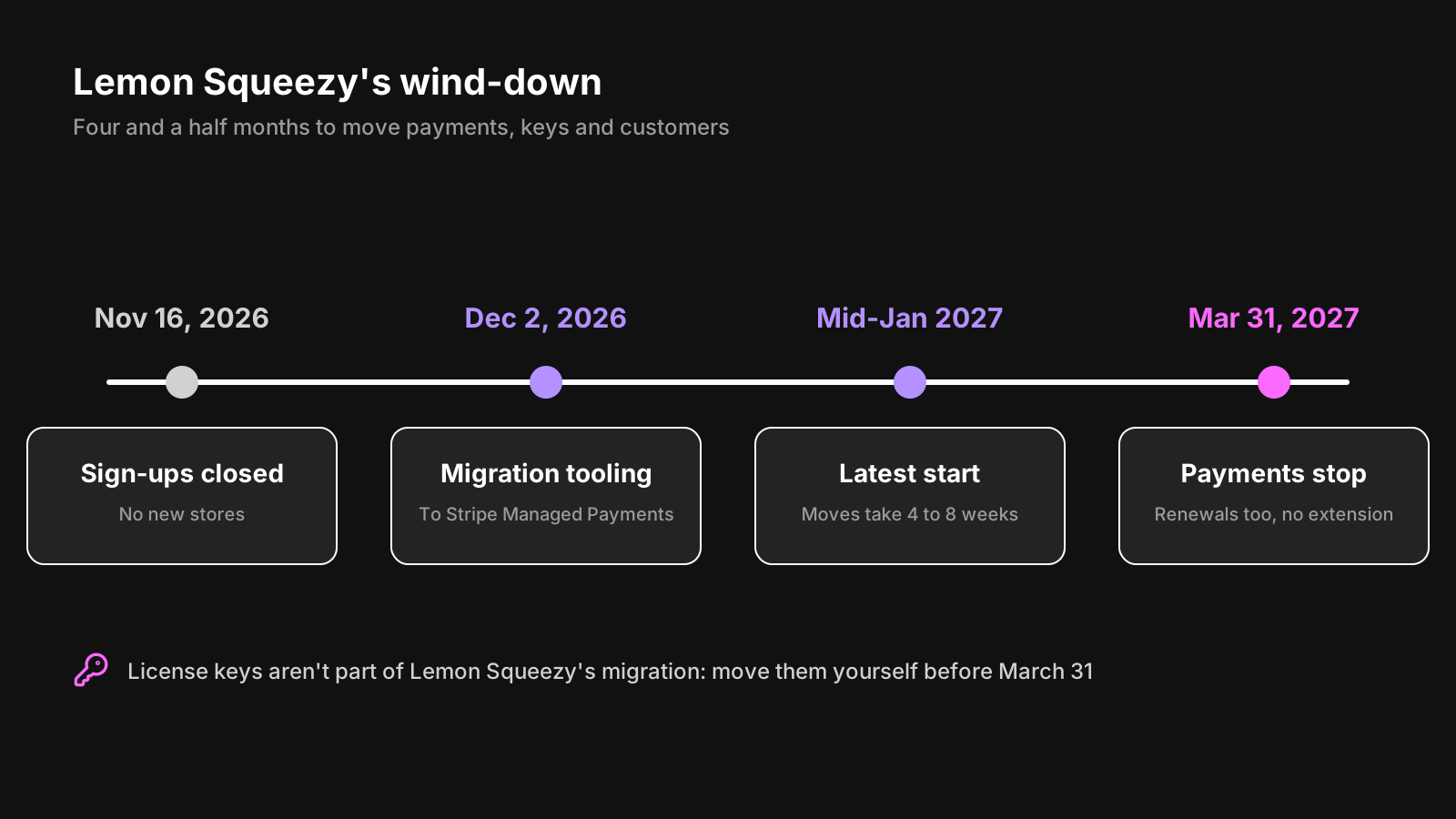
| Date | What happens |
|---|---|
| November 16, 2026 | New store sign-ups close. Merchants get an email with steps for their plan. |
| December 2, 2026 | Migration tooling to Stripe Managed Payments opens for eligible stores. |
| Mid-January 2027 | The latest date Lemon Squeezy recommends to start: a migration takes 4 to 8 weeks. |
| March 31, 2027 | Lemon Squeezy stops processing transactions, subscription renewals included. |
Four to eight weeks is longer than it sounds. Customers get at least 14 days’ notice before their subscription moves, you’ll want to test your new checkout, and you’ll probably ship an app update. Starting in December leaves room for surprises.
Where you can go: Managed Payments, or another provider
Your path depends on one thing: where your business is based.
If your country is supported by Stripe Managed Payments, Lemon Squeezy’s tooling moves you there. Managed Payments accepts businesses in the US, Canada, most of Europe and the UK, Australia, Hong Kong, Japan and Singapore, 37 locations in all. It’s also a merchant of record: Stripe’s Link sells to your customers and handles sales tax and VAT in more than 80 countries.
Its fee is 3.5% per transaction on top of Stripe’s processing fees, but merchants who migrate from Lemon Squeezy pay a promotional 1.5% until December 1, 2027. On a $49 sale with a US card, that’s about $2.46 during the promotion and $3.44 after, against $2.95 on Lemon Squeezy today. See Stripe Managed Payments vs Lemon Squeezy for the full comparison.
If your country isn’t supported, Lemon Squeezy can’t move you, and you need another provider: Paddle, Polar, FastSpring, or Stripe on your own with Stripe Tax. Lemon Squeezy offers a data export and an intake form to move card subscriptions to another processor. Lemon Squeezy alternatives compares them, and Lemon Squeezy to Paddle walks through the most common path.
What moves to Stripe Managed Payments, and what doesn’t
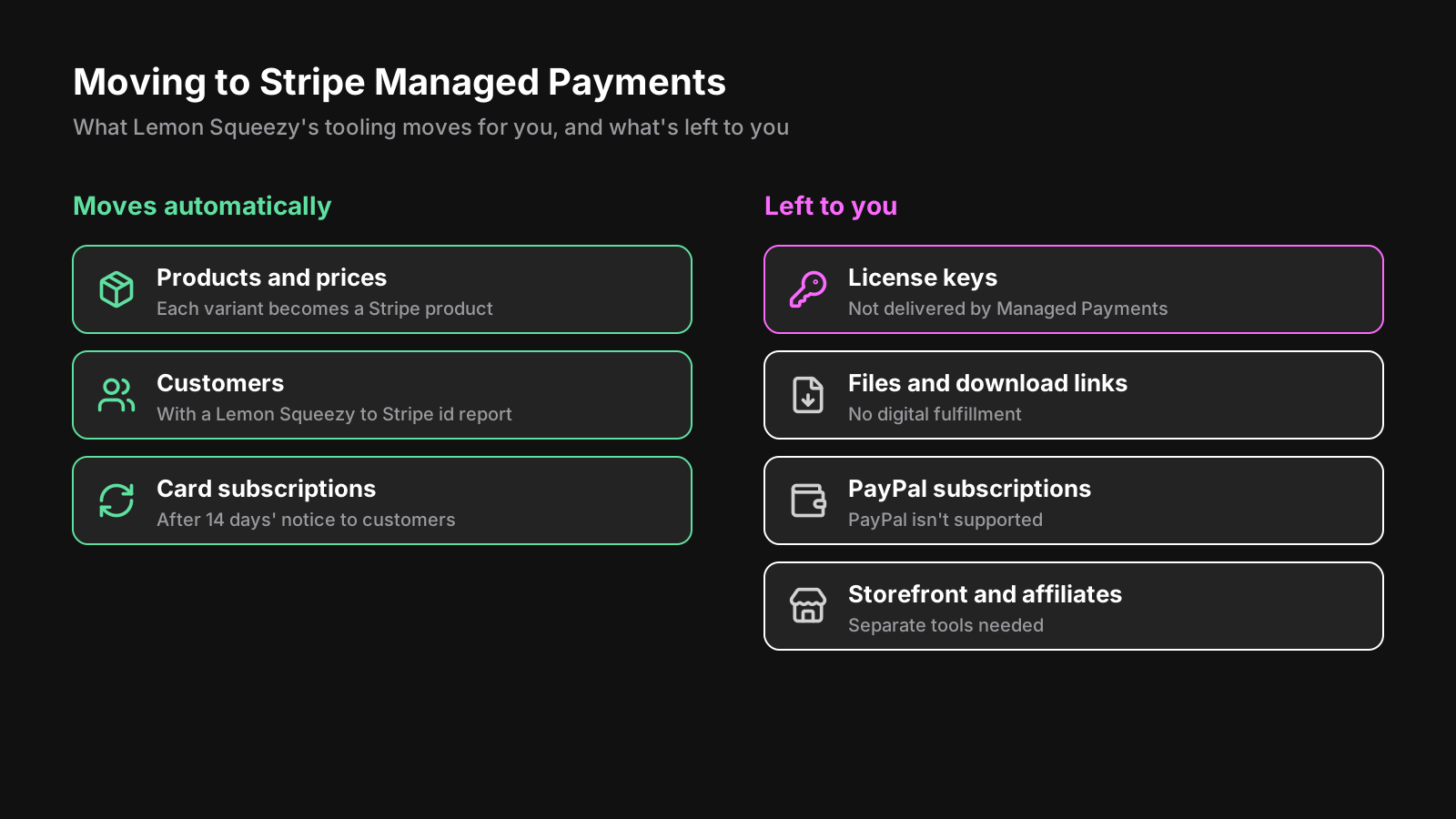
Lemon Squeezy’s migration tooling does a lot for you:
- Products and prices. It creates them in Stripe, starting in a sandbox. Stripe has no variants: each Lemon Squeezy variant becomes its own Stripe product.
- Customers. They’re copied to Stripe, with a report mapping each Lemon Squeezy customer id to its Stripe customer id.
- Card subscriptions. Eligible subscriptions move automatically, after at least 14 days’ notice to the customer, and most customers don’t re-enter their card.
And it leaves a lot to you:
- License keys. Managed Payments doesn’t generate or deliver them. Lemon Squeezy’s docs say you need “a separate solution”, and warn that customers may lose access to their keys after March 31.
- Files and download links. No digital fulfillment either: host your files elsewhere.
- PayPal subscriptions. Managed Payments doesn’t take PayPal. These customers have to subscribe again with a card. Lemon Squeezy advises removing PayPal from your checkout now, so no new PayPal subscriptions start.
- Checkout links, overlays and webhooks. None of your Lemon Squeezy URLs redirect. Every checkout link, embedded checkout, API call and webhook handler has to point to Stripe.
- Storefronts, affiliates and email marketing. All need separate tools.
License keys: the part nobody migrates for you
If you sell a desktop app, a plugin or any software that asks for a key, this is the part that matters most. Your customers have keys, and your app checks them with Lemon Squeezy’s License API, api.lemonsqueezy.com/v1/licenses/validate.
Two problems:
- New sales on Managed Payments don’t create keys. A customer who buys in April gets a receipt from Link and nothing to paste in your app, unless something creates and emails a key from Stripe’s webhooks.
- Old keys live in Lemon Squeezy. What happens to the License API after March 31 isn’t documented. Every copy of your app in the wild calls it. If it stops answering, apps that validate online on each launch lock their paying customers out.
So you need three things before the deadline:
- Somewhere for your existing keys, imported as they are, so nobody gets a new key.
- Something that creates keys from Stripe or Paddle sales, so April’s customers get one.
- An app update that validates keys there instead of with Lemon Squeezy, shipped early enough that most customers have it by March 31.
That’s what a licensing service does. LicenseManager imports your Lemon Squeezy keys from a CSV file, keeps them linked to the subscriptions Lemon Squeezy moved to Stripe, and creates a key for every new Stripe or Paddle sale. The details are in how to migrate Lemon Squeezy license keys.
Your Lemon Squeezy migration checklist
Now, in November:
- Check if your country is supported by Managed Payments, in Stripe’s supported business locations. This decides everything else.
- Remove PayPal from your checkout, if you’ll move to Managed Payments, so no new PayPal subscriptions start.
- Export your orders, from the Orders page of Lemon Squeezy: the CSV is emailed to you. Keep it, along with your tax documents, which you need to download before access ends.
- List what Lemon Squeezy does for you: file delivery, license keys, storefront, affiliates, emails, discount codes. Each needs a replacement.
- Count your license keys and your app versions that call the License API.
In December, once the tooling opens:
- Run the migration in the Stripe sandbox Lemon Squeezy creates, and review the products and subscriptions it lists.
- Set up your licensing: import your existing keys in a test product, connect Stripe, and map your new Stripe prices to your offers.
- Ship the app update that validates keys with your new licensing service, and turn on auto-updates if you haven’t (Electron, Tauri).
By mid-January:
- Start the live migration. Subscriptions move after their 14 days’ notice.
- Switch your checkout links to Stripe Checkout or Payment Links.
- Import your keys in the live product, linking each subscription key to its new Stripe subscription.
Before March 31:
- Import the keys sold since, until your checkout has fully moved. Importing again skips the keys already there.
- Tell customers on old app versions to update, by email, with the date.
- Download your tax documents and final reports from Lemon Squeezy.
What about affiliates, emails and discount codes?
Affiliates need a separate platform: Lemon Squeezy’s FAQ mentions Dub.co and a discount for Lemon Squeezy merchants. The affiliate program ends with the store, on March 31.
Email marketing isn’t part of Managed Payments, which only sends required transactional emails: move your lists to your email provider.
Discount codes aren’t covered by the migration docs beyond keeping the discounts of active subscriptions. Recreate the codes you still use as Stripe coupons and promotion codes.
Payouts keep coming: Lemon Squeezy says revenue from completed transactions is paid out in full, for accounts in good standing.
Build it yourself, or use a licensing service
You can replace license keys yourself: a webhook endpoint for checkout.session.completed and invoice.paid, a database of keys, an email, an endpoint your app calls, a way to free a machine, and an import of the old keys. It’s a few days of work to start, and then it’s yours to run: the server, the database, the edge cases of refunds and renewals, the customer who changed laptops.
LicenseManager does it for you, for Stripe, Stripe Managed Payments and Paddle:
- Your Lemon Squeezy keys, imported as they are, from a CSV file the migration guide helps you export. Subscriptions moved to Stripe keep renewing them.
- A key for each new sale, emailed to your customer, from the prices you map.
- SDKs for Electron, Tauri and Swift that validate keys, limit machines, and work offline with signed tokens, which Lemon Squeezy’s License API never did.
- Free help to move: we export your keys, import them and link your subscriptions with you. See leaving Lemon Squeezy.
Wrapping up
Lemon Squeezy is shutting down on March 31, 2027, and its tooling moves your products, customers and card subscriptions to Stripe Managed Payments, if your country is supported. License keys, files and PayPal subscriptions are left to you, and they’re what breaks a software business on April 1 if nobody takes care of them.
Start now: check your country, export your data, find a home for your license keys, and ship the app update early. Then compare your options in Lemon Squeezy alternatives, or go straight to migrating your license keys.