 LicenseManager
LicenseSpring is on your shortlist: SDKs for .NET, C++, Java, Python, Swift, Unity and more, floating licenses, and a free plan to start. The pricing page lists four plans and a column of limits. Which plan will a desktop app with a thousand customers need, and which limit decides it?
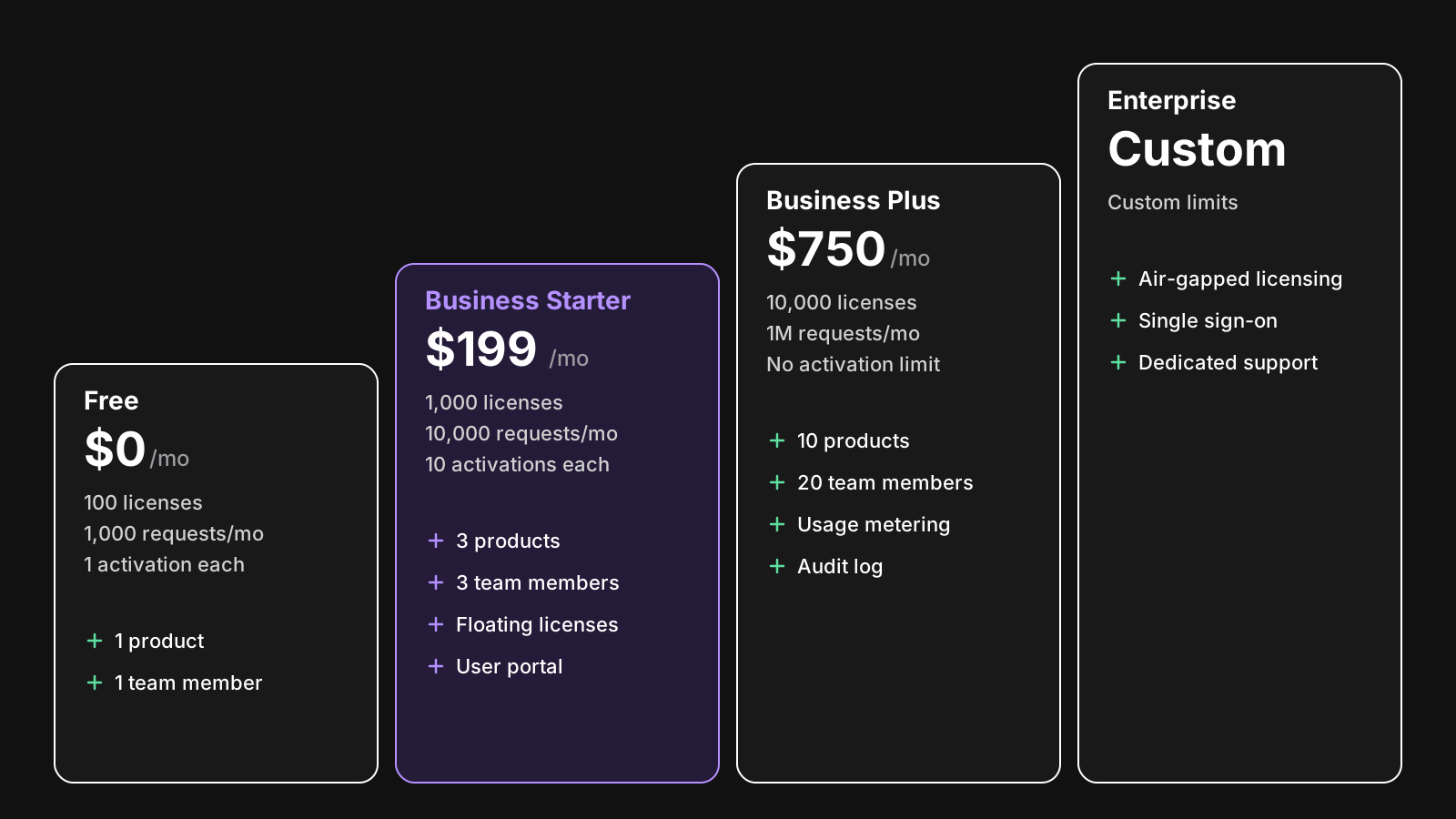
LicenseSpring pricing has a Free plan, Business Starter at $199 a month, Business Plus at $750 a month, and a custom Enterprise plan. The plans are limited by active licenses, API requests per month, products, team members and activations per license, and for a desktop app that checks its license on every launch, the API request limit is usually the one that decides.
This article goes through each plan, the limits that matter, what a typical app would pay, and how it compares with other licensing services. Prices are from LicenseSpring’s pricing page as of late 2026: check it before you decide, as plans change.
LicenseSpring plans at a glance
| Free | Business Starter | Business Plus | Enterprise | |
|---|---|---|---|---|
| Price per month | $0 | $199 | $750 | Custom |
| Active licenses | 100 | 1,000 | 10,000 | Custom |
| API requests per month | 1,000 | 10,000 | 1,000,000 | Custom |
| Products | 1 | 3 | 10 | Custom |
| Team members | 1 | 3 | 20 | Custom |
| Activations per license | 1 | 10 | No limit | Custom |
Prices are in US dollars, before taxes. Review sites still list a “from $99 a month” plan: that’s an older price, rely on the vendor’s page.
LicenseSpring also runs a startup program, with up to 75% off Business Plus for two years for eligible companies. If you qualify, Business Plus costs about the price of Business Starter, with a hundred times more API requests.
What each plan includes
Free
For building your integration: 100 active licenses, 1,000 API requests a month, one product, one team member. The limit that matters is one activation per license: a customer can’t use the same key on a laptop and a desktop. That’s fine for testing, and too strict for most paying customers.
Business Starter, $199 a month
The entry paid plan: 1,000 active licenses, 10,000 API requests a month, 3 products, 3 team members, and up to 10 activations per license. It includes the core of LicenseSpring: node-locked and floating licenses, trials, subscriptions through Stripe or FastSpring, offline activation, and the user portal.
Business Plus, $750 a month
10,000 active licenses and 1,000,000 API requests a month, 10 products and 20 team members, with no limit on activations per license. It adds usage-based metering (charging per use of a feature, like exports or API calls) and the immutable audit log.
Enterprise, custom
Custom limits, and the features for regulated or isolated customers: air-gapped licensing, where machines never reach the internet, single sign-on, and dedicated support. Priced on request.
The limit you’ll hit first: API requests
Every license check your app makes is an API request. A desktop app that validates its key on launch makes one request per launch, per computer, plus the renewals of its offline token.
Count it for your own app:
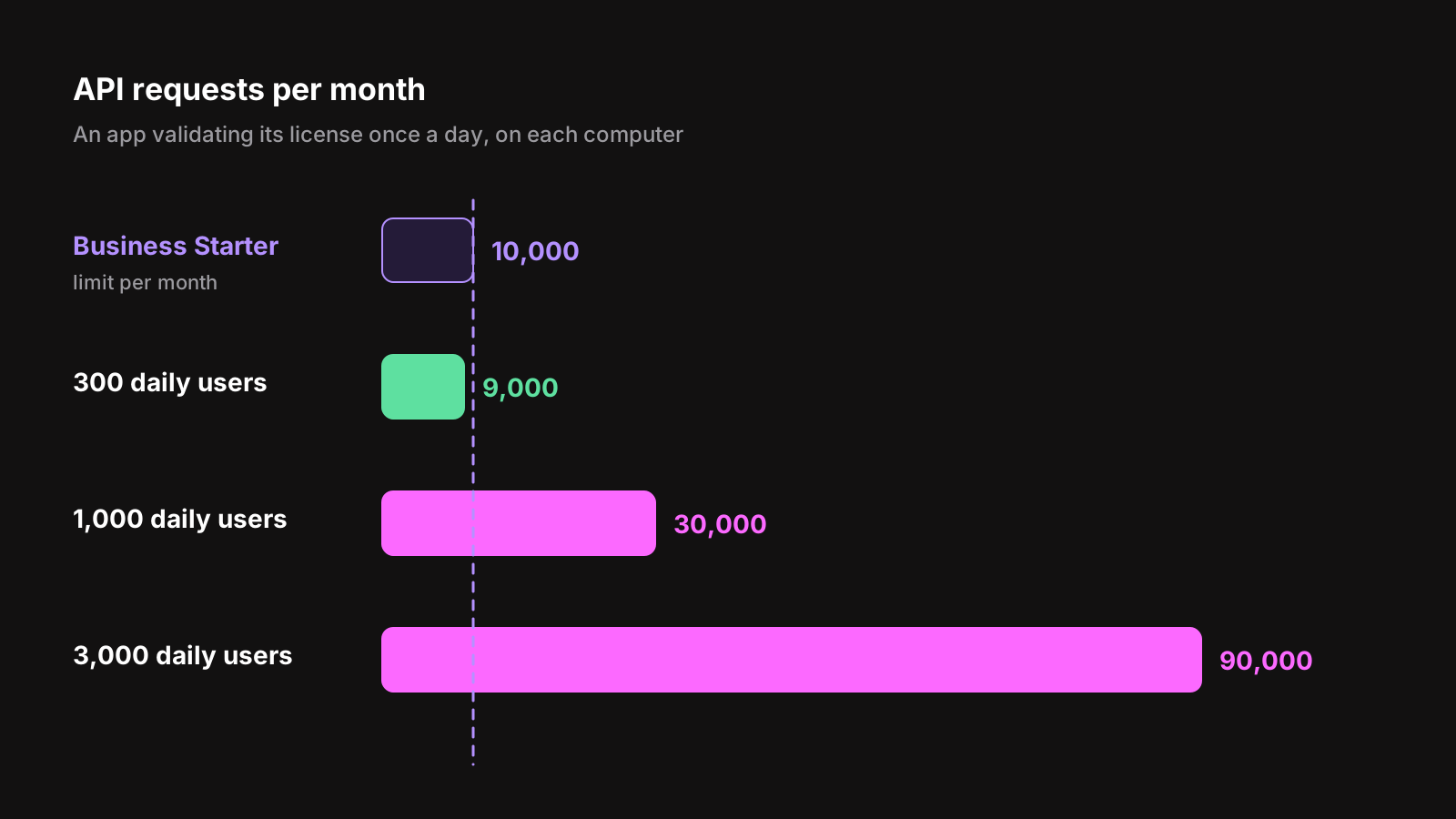
- 1,000 customers, opening the app once a day: about 30,000 requests a month. Three times Business Starter’s 10,000.
- 1,000 customers, opening it a few times a week: about 12,000 requests a month. Still over.
- 300 customers, once a day: about 9,000 requests. Just under.
You can lower the number of requests: validate once a day instead of on every launch, and rely on the offline token in between. But then a refunded or revoked license keeps working for up to a day, and you have to write and test that caching yourself. Ask LicenseSpring how its SDKs count requests, and what happens when you go over, before you size your plan: an app that can’t reach its license server is an app refusing paying customers.
The other limits rarely decide alone:
- Active licenses: 1,000 on Business Starter. A desktop app with 1,000 paying customers is right at the edge.
- Activations per license: 10 on Business Starter is plenty for a personal license on a few computers.
- Products: 3 on Business Starter. A test product for development counts as one, depending on how you set it up.
What a desktop app would pay
Three examples of an app sold to individuals, each customer opening it about once a day:
| Your app | Requests per month | Plan needed | Per month | Per year |
|---|---|---|---|---|
| 100 customers | about 3,000 | Business Starter (Free allows 1 activation per license) | $199 | $2,388 |
| 1,000 customers | about 30,000 | Business Plus | $750 | $9,000 |
| 5,000 customers | about 150,000 | Business Plus | $750 | $9,000 |
The first line is the surprise: even at 100 customers, the Free plan’s single activation per license pushes you to a paid plan as soon as customers use two computers. The second line is the common case: past a few hundred daily users, request volume moves you from $199 to $750 a month, unless you validate less often or qualify for the startup program.
LicenseSpring doesn’t take a percentage of your sales: you sell through Stripe, FastSpring or your own store, and pay those fees separately.
Is LicenseSpring worth it?
LicenseSpring’s strengths are breadth and enterprise features:
- SDKs for 9 platforms: .NET, C++, Java, Python, Node.js, Go, Unity, Swift and Android.
- Floating licenses with a cloud or on-premise floating server.
- Air-gapped licensing on Enterprise.
- Integrations with Stripe, FastSpring, Salesforce and HubSpot.
If you sell engineering, scientific or business software to companies that need floating seats, on-premise servers or air-gapped machines, those features justify the price, and few licensing services offer all of them.
For an indie developer or a small team selling a desktop app to individuals, the trade-off is different: a free plan too strict to launch on, $199 a month for the first paid plan, and a request limit that a few hundred daily users exceed.
How LicenseSpring pricing compares
Monthly prices for about 1,000 active customers who open the app daily, from each vendor’s pricing page, in late 2026:
| Service | Plan | Per month | Counts | Free plan |
|---|---|---|---|---|
| LicenseSpring | Business Plus (Starter allows 10,000 requests) | $750 | Active licenses and API requests | Yes, 100 licenses, 1 activation each |
| Cryptlex | Growth, for the customer portal | $300 | Active activations (devices) | No, 30-day trial |
| Keygen | Std 1 | $99 | Licenses active in the last 90 days | Yes, 100 licenses |
| Cryptolens | Business | $299 | Active licenses | Yes, 10 licenses |
| LicenseManager | Startup | €29 | Licenses validated in the last 90 days, 100,000 requests | Yes, 100 licenses |
Units differ, so compare with your own numbers: how many customers, how many computers each, and how often the app checks its license. Cryptlex pricing goes through the same exercise for Cryptlex, and our comparison pages go deeper: LicenseSpring vs LicenseManager, Keygen vs LicenseSpring, LicenseSpring vs Cryptolens, and the best LicenseSpring alternatives.
Questions to ask before choosing
Whichever service you consider:
- What counts as a request? Activations, validations, offline token renewals, dashboard calls?
- What happens over a limit? Refused requests right away, or a grace period?
- How many computers can a customer use? On the plan you can afford at launch, not the one above.
- What does it cost before you have customers? And at 10 times your current volume?
- How do you leave? Can you export licenses and keys, and import them elsewhere without asking customers for new keys? See migrating to LicenseManager.
Build it or use one
Building your own licensing replaces a monthly bill with a server to run: a database of keys, a payment webhook, signed tokens for offline use, machine limits and a customer portal. Software license server weighs that trade-off.
LicenseManager is built for developers selling desktop apps with Stripe or Paddle, in Electron, Tauri or Swift. The Free plan includes 100 active licenses and 10,000 API requests, with no limit on computers per license beyond the one you set. Paid plans start at €29 a month for 1,000 active licenses and 100,000 requests. Every feature is on every plan: machine activation, offline validation, Stripe subscriptions, the customer portal and test mode. Going over a limit starts a grace period, and your app keeps working. Floating licenses, air-gapped licensing and native C++ or Unity SDKs aren’t offered: if you need those, LicenseSpring is the better fit.
Wrapping up
LicenseSpring pricing starts with a Free plan limited to one activation per license, then Business Starter at $199 a month with 10,000 API requests, Business Plus at $750 with a million requests, metering and an audit log, and a custom Enterprise plan with air-gapped licensing. For a desktop app that checks its license on launch, request volume, not license count, decides the plan.
It’s a strong fit for software sold to companies that need floating seats and native SDKs on many platforms. For an app sold to individuals, compare the request limits and the entry price with services built for that case: see the best software licensing services for indie developers.